
· by Michael Blair, Nashville's Garage Door
When a garage door starts down and then goes back up, or won’t leave the open position at all, the first thing we check is the pair of safety reversing sensors near the floor. Openers made for sale in the US since January 1, 1993 fall under the federal Safety Standard for Automatic Residential Garage Door Operators, which requires protection against a closing door trapping someone, and a photo eye that reverses a closing door and keeps an open one from closing is one of the options it lists. They sit low on the tracks, where a bumped bin can push one out of line. If the sensors turn out fine, we move on to the opener itself, which is the work our opener repair crews do.
The photo eyes
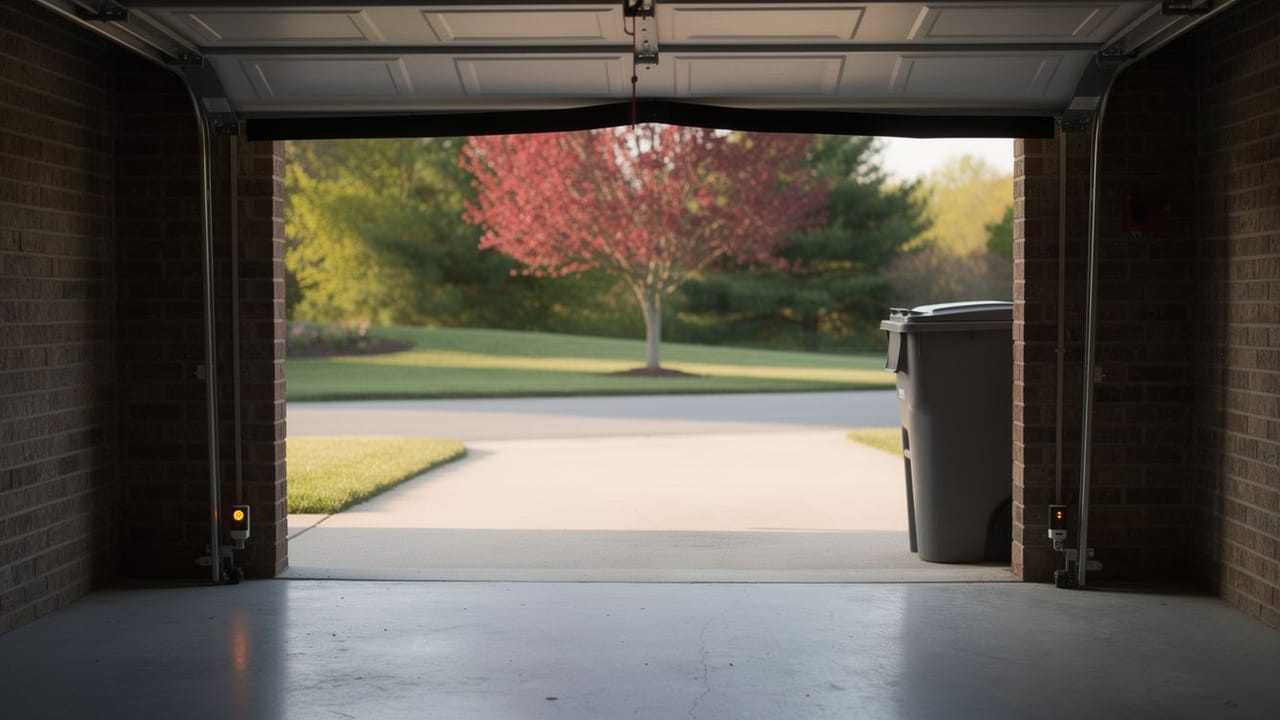
Two small sensors face each other across the door opening, one on each track. The maker of LiftMaster and Chamberlain openers says in its guide to aligning safety reversing sensors that they go no higher than six inches above the floor. Break or misalign the beam between them and the opener won’t close the door, which is exactly what the federal standard asks a photo eye to do.
Look at the indicator lights. On those two brands, the amber light is on the sending sensor and the green one on the receiving sensor; a blinking green means the pair is misaligned or something is in the way, and both lights out points to a wiring problem, according to Chamberlain’s alignment guide. If yours is another make, its manual will say what its lights mean. A cobweb, a leaf or a recycling bin sitting in the beam is enough to stop the door.
How do you realign garage door sensors?
We start by wiping both lenses and clearing the path. Then we loosen the bracket on one sensor, move it a little, tighten it and read the lights; on Chamberlain and LiftMaster units, two solid lights mean the pair is aligned and working. The same guide says to disconnect power before installing or adjusting sensors, so unplug the opener for each adjustment and plug it back in to check.
If the lights still won’t settle, follow each sensor wire back to the opener. Under the federal standard, an open or shorted sensor wire has to be treated as a fault: a closing door goes back up, and an open door won’t close more than a foot. That’s why a damaged wire looks just like a blocked beam. We look for staples driven through the wire and for loose ends at the opener terminals.
- Wipe both lenses
- Clear the beam path, including bins and cords
- Realign until both indicator lights are steady
- Check the wire run back to the opener for staples and loose ends
- Test the door from the remote or the wall control
Travel and force settings
With the sensors ruled out, look at the travel limits, the settings that tell the opener where the door should stop. Chamberlain’s note on why a garage door won’t fully close warns that limits set wrong will interfere with the safety reversal system. The pattern we look for is a door that reaches the concrete, reads it as something in the way and heads back up.
Force is adjustable on the opener too, but the same note is blunt: never use force adjustments to make up for a binding or sticking door. A door that seems to need more force is telling you something else is wrong, and turning it up takes away the margin that makes the door reverse when it meets something.
After any change to the limits or force, lay a 2x4 flat on the floor under the door and close it. The owner instructions the federal standard requires say the door must reverse on contact with a 1 1/2 inch object or a 2x4 laid flat, and that the opener should be tested monthly. It’s one of the checks in every tune-up we do.
When is a door that won’t close a spring problem?
If the door feels very heavy when you lift it by hand with the opener disconnected, or it won’t stay put partway up, we’d look at the springs before the opener. The instructions that come with every opener under the federal standard say to have a qualified service person make repairs to cables, spring assemblies and other hardware.
Those instructions also warn that weak or broken springs may allow the door to fall rapidly, causing injury or death. That’s the point to leave it alone and call us. Our spring replacement page explains how we handle that job.
Sources
- U.S. Consumer Product Safety Commission, 16 CFR Part 1211, Safety Standard for Automatic Residential Garage Door Operators (eCFR) — Applies to openers made on or after January 1, 1993 (1211.1); photoelectric sensor as one entrapment protection option and the sensor-wire fault rule (1211.8); required instructions on the monthly reverse test, emergency release, springs and qualified service (1211.16)
- Chamberlain Group, How to align safety reversing sensors — Sensors no higher than 6 inches above the floor; amber sending and green receiving LEDs; blinking green means misaligned or obstructed; both off means a wiring issue; disconnect power before adjusting
- Chamberlain Group, Why won’t my garage door fully close — Wrong travel limits interfere with the safety reversal system; never use force adjustments for a binding or sticking door
FAQ
Why Your Garage Door Will Not Close — questions
Why does my garage door reverse right before closing?
Often it’s the down travel limit: the door reaches the floor, the opener reads that as an obstruction and sends it back up. Something low in the sensor beam can do the same. Chamberlain warns that limits set wrong interfere with the safety reversal system and says never to use the force setting to make up for a door that binds, so correct the limit and leave the force alone.
Can I bypass the garage door sensors?
Don’t. The photo eyes are part of the entrapment protection the federal opener standard requires, there to stop a heavy closing door from trapping a person. If they won’t align, the fix is realigning them, repairing the wire or replacing the pair.
How do I know if the springs are the problem?
With the door fully closed, pull the emergency release, then lift the door by hand, carefully. If it is very heavy, or won’t stay where you leave it partway up, we’d suspect the springs. The warning the federal standard requires with every opener says to use the release only when the door is closed, because weak or broken springs can let a door fall rapidly. Spring work is a job for a qualified service person.
Why won’t my garage door close when the sensors are aligned?
A damaged sensor wire can stop it just as a blocked beam would, since the federal standard treats an open or shorted wire as a fault, so look for staples through the wire and loose ends at the opener. Then check the travel limits, which can send a door back up once it reaches the floor. Leave the force alone.