
· by Michael Blair, Nashville's Garage Door
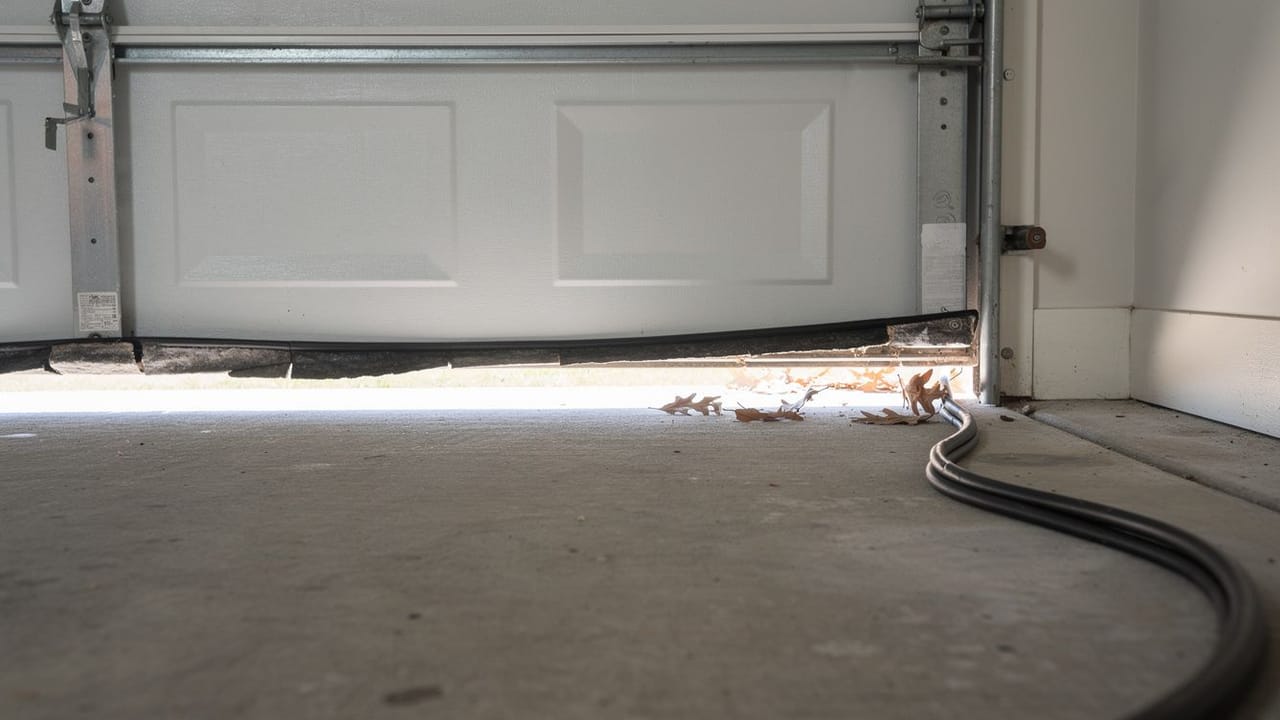
Stand in the garage with the door closed and the lights off on a sunny afternoon. If you can see a line of daylight along the floor, the bottom seal is not doing its job, and anything small enough to fit through that line is getting in. This time of year that can mean leaves blowing in, cold air creeping along the floor, rain pushed under the door in a storm, and in some garages a mouse or two. If you are thinking about an insulated door to keep that cold out, our look at when an insulated garage door is worth it explains why we check this strip first. The fix is usually simple, but the reason the gap is there isn’t always the seal.
How is a garage door bottom seal attached?
On most of the steel doors we work on, the bottom seal is a rubber or vinyl strip that slides into an aluminum retainer running the width of the bottom panel. The profile varies from door to door, and we see flat T-style strips, looped bulbs and J-shaped ones. Retainers differ between door makers too, so we match a replacement to the channel it has to slide into, not just to the width of the opening. Bringing a piece of the old seal to the supplier, or measuring the slot, saves a second trip.
Some wood doors and some older steel ones have no retainer, and the seal is nailed or screwed straight to the bottom edge. Wood needs more looking after in general: Amarr’s maintenance guide tells owners of wood doors to inspect them at least once a year for weathering and to strip and refinish when flaws start to show. When we put a new strip on a wood door, we paint or seal that bottom edge first, since it is the part sitting closest to a wet slab.
When the seal is not the problem
Garage slabs can settle and crack over the years, and some end up with a dip toward the middle of the opening or a low side, so the floor is no longer a straight line. A door is straight. A new seal will close a small dip, but it won’t bridge a slab that has dropped further than the bulb can reach, and the gap comes back at the low spot.
Options there include a taller bulb seal, a threshold strip bonded to the slab that gives the door something to land on, or, for a badly broken apron, concrete repair. A threshold can change how water runs across the floor, and it is one more thing to step over or roll a mower across, so we only put one where the door lands and nowhere else. Signs worth checking for:
- Daylight under the closed door at one end or across the middle
- Leaves or grit collecting just inside the door after wind
- Water on the floor after a storm, tracking in from the opening
- Rubber that is cracked, flattened or stiff to the touch
- Chewed notches, which can mean rodents have been working at it
The mistake with the opener
When the door stops short of the floor, the tempting fix is to turn up the opener’s force so it pushes harder into the slab. We don’t start there. An opener is built to back off when it meets resistance: the federal safety standard for residential garage door openers, 16 CFR Part 1211, requires a closing door to start reversing within 2 seconds of contact with an obstruction. Amarr’s guide suggests holding the bottom of the door as it closes, and says that if it won’t reverse easily, the force may be set too high. Force raised to crush a seal is force that also lands on whatever else ends up under the door.
The order we follow is the right seal first, then the down limit set so the door just meets it, then the reversal test. That same standard’s homeowner instructions say the door must reverse on contact with a 1 1/2 inch object, or a 2 by 4 board laid flat on the floor, that the test should be done monthly, and that the opener should be retested after adjusting either the force or the limit of travel. A taller new seal may need the limit adjusted, because the door now meets the floor a little sooner than it did. If it doesn’t reverse on the board, the job isn’t finished. Our tune-up and safety check covers this test, and if the door won’t come all the way down for other reasons, our post on why a garage door will not close goes through the usual causes.
Can you replace a garage door bottom seal yourself?
Sliding a new strip into a retainer is a reasonable homeowner job. We raise the door to about waist height, lock it so it can’t drift, unplug the opener, and pull the old strip out one side. A little dish soap on the new one helps it slide. Work from the inside face of the door and stay out from under it; the same federal instructions put it in capitals: never go under a stopped, partially open door.
Leave the bottom brackets alone. The lift cables run from the spring system to the bottom brackets on each side, and DASMA’s garage door safety tips say those brackets are under extreme tension because they connect to the springs, and that only a trained door systems technician should adjust or loosen them. If the retainer itself is bent, split or corroded, the fix involves that bracket, and it is one for our crew rather than a Saturday project. You can ask us for a free estimate and we’ll look at the seal, the slab and the opener settings on the same visit.
Sources
- U.S. Consumer Product Safety Commission, 16 CFR Part 1211: Safety Standard for Automatic Residential Garage Door Operators (eCFR) — Reversal within 2 seconds of contact; monthly test with a 1 1/2 inch object or a 2 by 4 laid flat; retest after adjusting force or travel limit; never go under a stopped, partially open door
- Amarr, Maintaining and Cleaning Garage Doors and Openers — Inspect wood doors yearly for weathering and refinish when flaws show; hold the door bottom as it closes, and force may be excessive if it will not reverse easily
- Door & Access Systems Manufacturers Association (DASMA), Garage Doors safety tips — Cables attach the spring system to the bottom brackets; bottom brackets are under extreme tension and should be adjusted or loosened only by a trained technician
FAQ
Garage Door Bottom Seals and the Gaps They Leave — questions
How often does a garage door bottom seal need replacing?
We don’t go by a fixed schedule. Replace it when the rubber is cracked, stiff, flattened or chewed, or when you can see light under the closed door. A quick look every time you check the rest of the door is enough to catch it.
Why does my garage door reverse after I put on a new seal?
A thicker or taller seal can touch the floor earlier in the travel, and the opener may treat that as something in the way. The fix is usually adjusting the down limit as the opener manual describes, then retesting with a 2 by 4 laid flat under the door, rather than turning up the force. The federal opener standard calls for that retest after any change to force or travel.
Will a new bottom seal keep mice out of the garage?
It closes the largest gap at the floor, but it is not the only opening. We also check that the stop molding along the sides and top touches the door face evenly, and look for gaps where the slab meets the wall, because any of those left open is another way in.
Why is my garage door not sealing at the bottom?
Either the seal has worn out or the floor has moved. Cracked, flattened or stiff rubber stops pressing on the concrete, and a slab that has settled into a dip or a low side can drop further than a new seal can reach. A taller bulb seal, a threshold strip or concrete repair closes that kind of gap.