
· by Michael Blair, Nashville's Garage Door
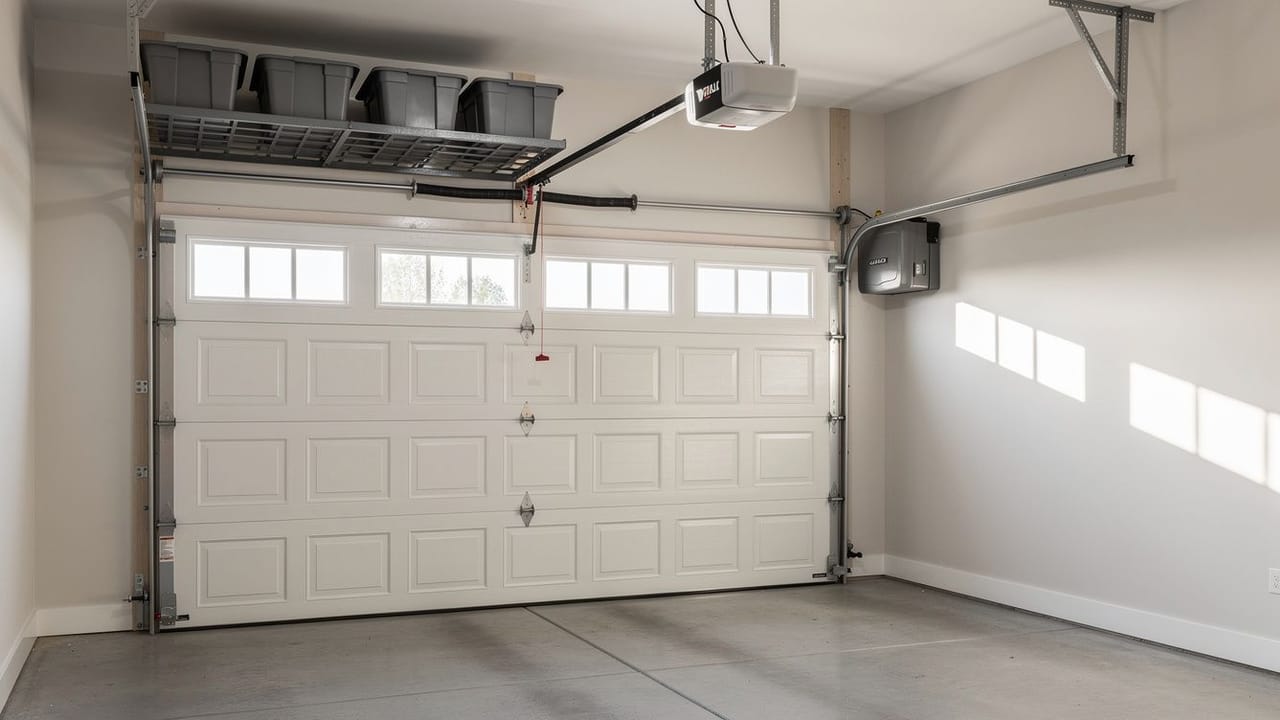
The openers we install move the door in different ways: a chain or a belt pulling it along a rail on the ceiling, or a motor on the wall beside the door. In a house with a bedroom or bonus room above the garage, that difference is the one you’ll hear every day, so it’s the first thing we settle before an opener installation.
The three common types
Chain and belt drives are built alike. A motor hangs from the ceiling and pulls a trolley along a rail toward the door, which is why the federal opener standard, 16 CFR Part 1211, refers to them as trolley-driven operators. What differs is the part doing the pulling, a metal chain or a reinforced rubber belt, and from the room upstairs it’s the chain people complain to us about.
A jackshaft opener mounts on the wall beside the door instead, so there is no rail across the ceiling and nothing bolted to the joists under the bedroom. Direct drive is a separate design rather than another name for a jackshaft; it still hangs from a ceiling rail, so if a quote says direct drive, ask where the motor will go.
Which suits which garage
Detached garage, no living space nearby: a chain drive is a reasonable choice, and its noise has nowhere to go but the yard.
Bedroom or bonus room above: a belt at minimum, and a jackshaft if the budget allows and we find the door suits one. With the rail gone, the ceiling is free for overhead storage racks too.
- Chain: metal chain on a ceiling rail, fine for a detached garage
- Belt: reinforced rubber belt on the same kind of rail, our usual pick for an attached garage
- Jackshaft: mounted on the wall beside the door, no ceiling rail
- Direct drive: still on a ceiling rail, not the same machine as a jackshaft
- Battery backup: the first feature we’d add to any of them
Which garage door opener features are worth having?
Battery backup comes first on our list. When a storm knocks the power out, an opener without it can’t move the door, and the way out is the manual release, the red-handled cord that 16 CFR 1211.9 requires on openers attached to the door. That section says a firm pull of no more than 50 pounds has to free it, but from there you are lifting the door yourself, which we walk through in our post on opening a garage door when the power is out.
Wi-Fi control lets you check the door and close it from your phone. Closing a door nobody is standing there to watch is what 16 CFR 1211.14 calls unattended operation: the feature has to be switched on deliberately, a light and a sound have to warn for at least 5 seconds before the door moves, and it isn’t permitted at all on one-piece or swinging doors. If your opener is old enough that you’re unsure how its remotes are coded, our post on how garage doors get opened covers that.
Does a more powerful opener handle a heavy door better?
A common misconception is that a more powerful opener handles a heavy door better. The way we explain it, the springs carry the weight and the opener only moves a door that is already balanced. The installation warnings in 16 CFR 1211.16 start from the same place: an opener goes only on a door in proper balance, and a qualified service person fixes the cables and spring assemblies before it goes up.
If a door is hard for the opener, the answer is balancing the door and checking the springs, not buying a larger motor to fight it. DASMA’s garage door system safety tips say a door that stays awkward when moved by hand may have a spring system out of balance, which wears other door parts out early. That is a job for our spring repair crew, and when you want either one looked at, ask us for a free estimate.
Sources
- U.S. Consumer Product Safety Commission, 16 CFR Part 1211, Safety Standard for Automatic Residential Garage Door Operators (eCFR) — The federal opener standard; section 1211.6(b)(3)(ii) names trolley-driven operators
- eCFR, 16 CFR 1211.9, Additional entrapment protection requirements — Manual release with a red handle required on operators attached to the door; detaches with a maximum of 50 pounds of force
- eCFR, 16 CFR 1211.14, Unattended operation requirements — Intentional action to enable; audible and visual alarm for at least 5 seconds before closing; not permitted on one-piece or swinging doors
- eCFR, 16 CFR 1211.16, Instruction manual — Install only on a properly balanced door; have a qualified service person repair cables and spring assemblies
- Door & Access Systems Manufacturers Association (DASMA), Garage Door Systems safety tips — Awkward manual operation may mean a spring system out of balance, causing premature wear on other door components
FAQ
Chain, Belt or Direct Drive Openers — questions
Is a belt drive opener much quieter than a chain?
In the homes we work in, the chain is the one people notice, and the difference shows most from a room right above the garage. If you want the ceiling rail gone altogether, a wall-mounted jackshaft is the other option. For an attached garage with living space above, a chain drive is the one we steer people away from.
Do I need a more powerful opener for a heavy door?
Usually not. The federal opener standard tells installers to fit an opener only to a properly balanced door and to have spring and cable repairs done first, and DASMA, the trade association for door and opener makers, says a door that is awkward to move by hand may have its springs out of balance, which wears other parts early. Balancing the door is the fix; a bigger motor just works against the same problem.
Is battery backup on an opener worth it?
We think so, and it is the first feature we suggest. Without it, an outage leaves you with the manual release, the red handle the federal standard requires on openers attached to the door. It has to free the door with no more than 50 pounds of pull, but after that you lift the door by hand until the power comes back and it is reconnected.
What type of garage door opener is best?
It depends on what is around the garage. For a detached garage with no living space nearby, a chain drive is a reasonable choice. With a bedroom or bonus room above, we would go to a belt at least, or a wall-mounted jackshaft if the door suits one. Whatever the type, we would add battery backup.